
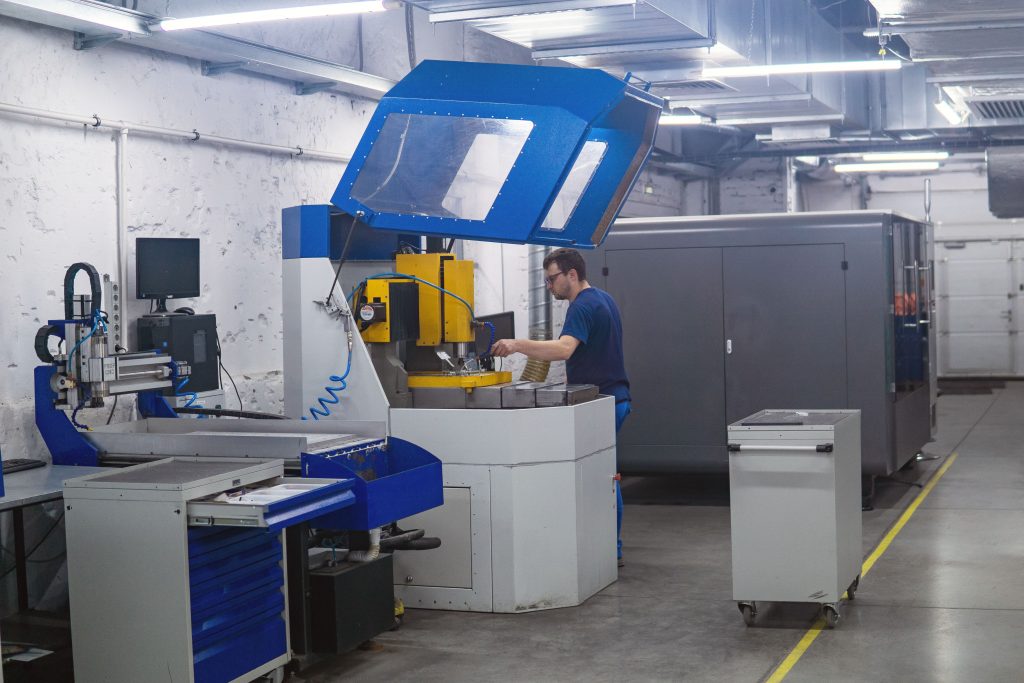
CNC lathe machines are a core part of modern manufacturing, used wherever rotational parts require high accuracy and consistency. They automate the traditional turning process through computer control, allowing precise, repeatable material removal. Found in industries ranging from automotive to aerospace, CNC lathes remain one of the most widely used machine tools in production environments today.
What is a CNC lathe machine?
A CNC lathe machine is a computer-controlled version of the traditional lathe, designed to rotate a workpiece while a cutting tool removes material to create cylindrical, conical, or contoured shapes. The key difference lies in automation—rather than being manually operated, a CNC lathe follows programmed instructions (G-code) to execute precise movements of both the spindle and cutting tool.
This computer control enables exceptional accuracy, repeatability, and efficiency, especially for high-volume production. CNC lathes are capable of performing multiple operations—such as turning, facing, threading, boring, and grooving—in a single setup, minimizing downtime and operator input. Modern models often include features like automatic tool changers, live tooling, and sub-spindles, allowing complex components to be fully machined without manual repositioning.
Benefits of CNC lathe machines
- High precision and accuracy – CNC lathes deliver exceptional dimensional control, capable of achieving micrometer-level tolerances even across long production runs. This precision is made possible by advanced servo motors, closed-loop feedback systems, and stable machine structures that eliminate vibration and thermal distortion. As a result, parts maintain consistent quality and tight geometric tolerances—essential in industries like aerospace, automotive, and medical device manufacturing.
- Efficiency and speed – Automation allows CNC lathes to perform cutting, threading, and drilling operations continuously with minimal downtime. Features such as automatic tool changers, sub-spindles, and optimized feed and speed settings reduce cycle times dramatically compared to manual machining. Many modern turning centers can run unattended for extended periods (“lights-out” machining), further improving throughput and operational efficiency.
- Versatility – A single CNC lathe can perform multiple machining operations, including turning, facing, threading, boring, grooving, and even milling when equipped with live tooling. This capability eliminates the need for multiple setups and machines, reducing part handling and setup errors. It also allows manufacturers to handle diverse part geometries—from simple shafts to intricate, multi-featured components—on one platform.
- Reduced human error – Because CNC lathes operate based on programmed instructions, they remove the variability associated with manual operation. Once a program is verified, the machine executes each part identically, ensuring consistent quality from the first piece to the last. Automated control also improves safety by minimizing direct operator involvement during cutting and tool changes.
- Scalability – CNC lathe systems can easily adapt to changing production demands, from single-piece prototypes to full-scale production batches. The ability to store and recall machining programs allows for rapid setup and repeatability when switching between parts. This flexibility makes CNC lathes ideal for both custom machining and mass production environments.
- Integration-ready – Modern CNC lathes are designed to integrate seamlessly with auxiliary systems such as robotic loaders, bar feeders, part catchers, and in-process measurement probes. This connectivity supports full automation, enabling continuous production with minimal supervision. Integration with CAD/CAM software and digital monitoring systems also enhances traceability, predictive maintenance, and overall manufacturing efficiency.
Types of CNC lathe machines
- 2-axis CNC lathe – The most common and fundamental configuration, featuring movement along the X and Z axes for turning, facing, and threading operations. These machines are ideal for producing simple cylindrical parts efficiently, offering a reliable and cost-effective solution for both prototyping and high-volume production of standard geometries.
- 3-axis and 4-axis CNC lathes – These machines add an additional degree of movement, allowing the tool turret or spindle to approach the workpiece from different angles. This enables more complex features such as angular cuts, undercuts, and cross-drilled holes, making them well-suited for components that require intricate detailing or multiple operations in one setup.
- CNC turning centers – A more advanced evolution of the lathe, these machines integrate live tooling, sub-spindles, and Y-axis movement to perform turning, milling, drilling, and tapping without part transfers. Their multi-tasking capability enhances productivity and precision, making them ideal for complex parts and continuous, automated production environments.
- Swiss-type CNC lathe – Characterized by a sliding headstock and guide bushing system, this configuration supports the workpiece close to the cutting zone to minimize deflection. It’s specifically designed for long, slender parts that demand ultra-high precision, such as medical implants, miniature connectors, and electronic components.
- Vertical CNC lathe – With the spindle oriented vertically, these machines use gravity to stabilize large and heavy workpieces during machining. This setup allows for exceptional rigidity and accuracy when producing components like turbine housings, flywheels, or heavy flanges, making vertical lathes indispensable in aerospace, energy, and heavy equipment manufacturing.
Key components of CNC lathe machines
- Bed – The rigid foundation that supports the entire machine structure, maintaining alignment and absorbing cutting forces. It is typically made from cast iron or polymer concrete for maximum rigidity and vibration damping, ensuring smooth cutting and consistent dimensional accuracy even during heavy-duty operations. The precision of the bed’s guideways directly influences the overall accuracy and stability of the machining process.
- Headstock – Houses the spindle, bearings, and motor system responsible for rotating the workpiece. It is designed for maximum stiffness and balance to minimize vibration and runout during high-speed rotation. In modern CNC lathes, the headstock may include an integrated spindle motor with electronic speed control for enhanced precision and energy efficiency.
- Spindle – The rotating shaft that holds the chuck or collet, providing the torque and speed required for cutting. Precision bearings within the spindle assembly ensure smooth, stable operation and minimal radial error. Advanced spindles often include encoders for real-time feedback, allowing for synchronized operations such as threading or live-tool machining.
- Chuck or collet – The clamping device that secures the workpiece firmly in place. Hydraulic or pneumatic actuation ensures quick, repeatable part changes, which is critical for maintaining production efficiency. The choice between chucks and collets depends on part geometry—chucks handle larger diameters, while collets provide superior grip for smaller, high-precision components.
- Turret – A rotating tool holder that allows multiple cutting tools to be preloaded and indexed automatically during operation, reducing downtime between tool changes. Turrets can hold both static and live tools, enabling turning, drilling, and milling operations within one cycle. Their indexing precision and rigidity are key to maintaining tool position accuracy during complex multi-step machining.
- Tailstock – Supports long or slender workpieces during machining to prevent deflection and maintain accuracy. It can be adjusted along the bed to accommodate different workpiece lengths and is typically equipped with a live or dead center. In CNC machines, tailstocks may be motorized or automatically positioned for improved repeatability and faster setups.
- Control panel – The interface where operators input and adjust machining programs, speeds, and feeds. Advanced panels feature touchscreen displays, user-friendly controls, and integration with CAD/CAM systems for direct program transfer. Real-time monitoring and diagnostic tools allow operators to track spindle loads, tool wear, and production status with high visibility.
- Coolant system – Delivers coolant directly to the cutting zone to manage heat, extend tool life, and improve surface finish. Proper coolant flow prevents chip buildup and helps maintain dimensional stability during prolonged operations. Many CNC lathes now feature programmable coolant nozzles and filtration systems to optimize cooling efficiency and reduce maintenance downtime.
Common operations performed on CNC lathes
CNC lathe machines are capable of a wide variety of machining operations, including:
- Turning – Removing material along the length of the workpiece to achieve the desired diameter and shape. This is the most fundamental lathe operation, producing smooth, concentric cylindrical surfaces with precise control over dimensions and tolerances. CNC programming ensures uniformity across multiple parts and allows for complex profiles to be machined in one pass.
- Facing – Creating flat surfaces perpendicular to the axis of rotation, typically at the ends of the workpiece. This operation ensures the part’s face is square to the axis, providing a clean reference surface for assembly or further machining. CNC control allows for consistent surface finishes and precise depth control, even on complex geometries.
- Threading – Cutting internal or external threads with high precision and repeatability. The synchronization between spindle rotation and tool feed in CNC lathes ensures consistent thread pitch and form, whether producing standard, tapered, or custom threads. Threading is crucial in manufacturing components like bolts, fittings, and connectors.
- Boring – Enlarging existing holes to exact dimensions and improving internal surface quality. Boring achieves tighter tolerances and smoother finishes than drilling alone, making it essential for parts requiring precise fits, such as housings, sleeves, and bearing seats. CNC systems allow accurate depth control and repeatable performance across batches.
- Grooving and parting – Cutting recesses or separating the finished part from the stock material. Grooving is often used for O-ring seats, retaining clips, or aesthetic features, while parting (cutoff) cleanly removes the completed workpiece. CNC control ensures precise groove placement and prevents tool breakage by optimizing feed and coolant flow.
- Knurling – Producing a patterned texture on the workpiece surface for better grip or visual appeal. This is achieved by pressing a hardened, patterned roller against the rotating workpiece. Knurling is commonly applied to handles, knobs, and fasteners, and CNC control ensures uniform pattern depth and spacing.
- Drilling and tapping – Performed using live tooling on advanced CNC turning centers, allowing holes and threads to be added without removing the part from the machine. This integration saves setup time and ensures perfect alignment between turned and drilled features, improving both accuracy and productivity in complex component manufacturing.
Industry applications of CNC lathes
- Aerospace – CNC lathes are used to manufacture high-precision components such as shafts, landing gear parts, and turbine engine elements that must withstand extreme stress and temperature variations. The ability to maintain tight tolerances and superior surface finishes ensures consistent performance and reliability in flight-critical applications.
- Automotive – In the automotive industry, CNC lathes produce gears, pistons, axles, and drive components with exact dimensional accuracy to ensure proper fit and performance. Their speed and repeatability make them ideal for large-scale production lines, supporting both engine part manufacturing and precision finishing for transmission systems.
- Medical – CNC lathes play a key role in producing surgical instruments, orthopedic implants, and dental components that require exceptional precision and biocompatible surface finishes. The capability to machine small, intricate parts from titanium, stainless steel, and other medical-grade materials makes them indispensable in modern healthcare manufacturing.
- Oil and gas – These machines are used to create durable valve bodies, couplings, flanges, and threaded pipe fittings capable of withstanding high pressures and corrosive environments. CNC lathes provide the precision and consistency needed for sealing surfaces and threaded connections used in drilling, extraction, and refinery operations.
- General engineering – CNC lathes are widely applied in manufacturing bushings, rollers, fasteners, pulleys, and custom fittings across multiple sectors. Their flexibility allows for quick adaptation to diverse materials and geometries, supporting everything from small custom parts to high-volume industrial components with reliable accuracy.
Conclusion
CNC lathe machines embody the perfect blend of precision, automation, and adaptability in modern manufacturing. Their ability to perform multiple operations in a single setup reduces waste, boosts productivity, and ensures exceptional part quality across every production run. As digital integration, live tooling, and automation continue to advance, CNC lathes are evolving into even more capable, intelligent systems. Whether for high-volume production or specialized component machining, they remain a cornerstone of efficiency and innovation in the global manufacturing landscape.