
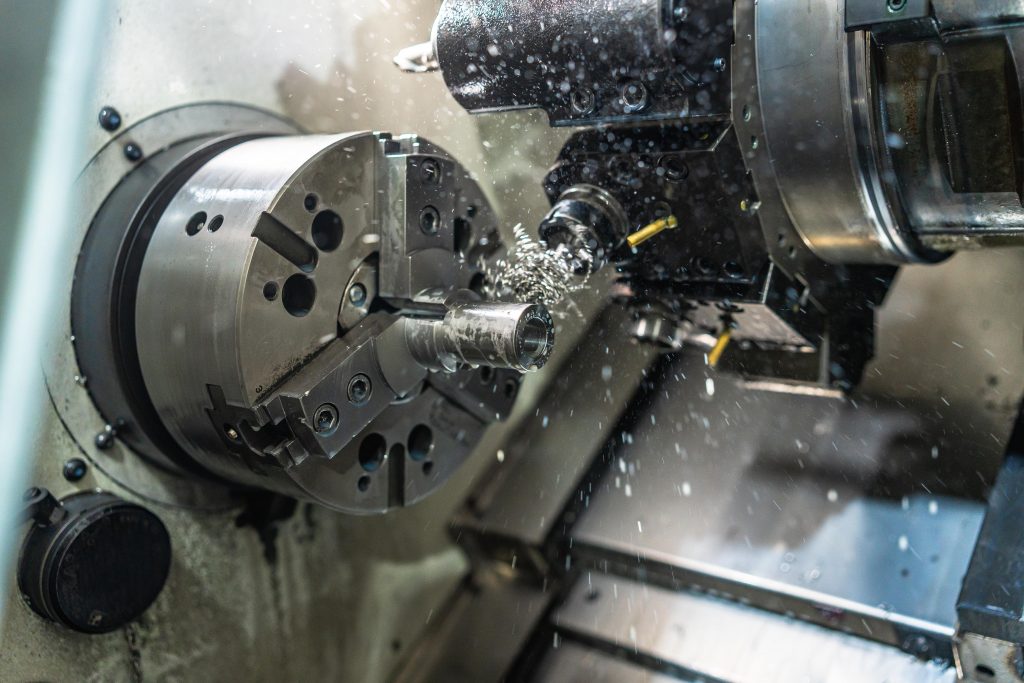
Turning machines are among the most fundamental tools in precision manufacturing, shaping countless cylindrical components used across industries. Their ability to combine rotational motion with controlled cutting makes them indispensable for producing accurate, repeatable parts at scale. Understanding how turning machines work, their components, and their capabilities reveals why they remain a cornerstone of modern machining.
What is a CNC turning machine?
A turning machine is a machine tool used to remove material from a rotating workpiece using a stationary or linearly moving cutting tool. The process—known as turning—creates components with rotational symmetry, such as shafts, bushings, and threaded parts.
Unlike milling, where the cutting tool rotates and the workpiece remains stationary, in turning the workpiece itself spins at high speed while the tool advances into it. Turning machines are controlled manually or, in most modern environments, through computer numerical control (CNC) for improved precision and automation.
How a turning machine works
The turning process is built on a straightforward yet powerful principle: the rotation of the workpiece combined with the controlled movement of a cutting tool. This combination allows precise shaping of cylindrical and conical surfaces with high repeatability. The workflow typically includes:
- Workholding – The workpiece is securely clamped in a chuck, collet, or between centers on the spindle. Stable workholding is critical to maintaining concentricity and preventing chatter or vibration during cutting. Depending on the application, manual, hydraulic, or pneumatic chucks may be used to ensure consistent grip and rapid part changeovers, particularly in CNC environments.
- Rotation – The spindle motor drives the workpiece at a programmed speed, which is carefully selected based on factors such as material type, tool geometry, and desired surface finish. High spindle speeds are used for finishing operations, while lower speeds are preferred for roughing or hard materials. The precision of spindle bearings and balance directly impacts part accuracy and surface quality.
- Tool engagement – A single-point cutting tool, typically made from carbide, ceramic, or high-speed steel, is mounted on the carriage or turret and advanced into the rotating workpiece. The tool can feed longitudinally (along the axis) for turning operations or transversely (across the face) for facing. In CNC turning centers, multiple tools are preloaded in a turret, allowing automatic changes between operations for continuous machining.
- Feed and speed control – Feed rate, spindle speed, and depth of cut are optimized for each operation to achieve the ideal balance between productivity, surface finish, and tool wear. CNC systems precisely synchronize these parameters, ensuring smooth cutting conditions and consistent chip formation. Proper control of these variables also helps manage heat generation and extend tool life.
- Continuous monitoring – In modern CNC turning, sensors and feedback systems continuously track tool position, spindle load, vibration, and cutting forces. These systems help maintain tight dimensional tolerances, detect potential tool breakage, and automatically adjust parameters to ensure consistent performance. Real-time monitoring enhances process reliability, reduces scrap rates, and supports fully automated production cycles.
Benefits of turning machines
- High precision – Turning machines are capable of maintaining extremely tight dimensional tolerances, ensuring accuracy in producing cylindrical and concentric components. The rotational nature of the process provides inherent symmetry, while precision spindles and rigid construction minimize vibration and deflection. This makes turning ideal for critical components such as shafts, bearings, and threaded parts.
- Versatility – A single turning machine can perform multiple operations, including turning, facing, threading, boring, drilling, and grooving. Modern CNC turning centers extend this flexibility further with live tooling and Y-axis capabilities, allowing both turning and milling operations within one setup. This versatility helps manufacturers reduce machine setups and optimize floor space.
- Efficiency – CNC turning centers significantly reduce cycle times through high-speed machining, automated tool changes, and optimized cutting parameters. Automated toolpath control and continuous operation make them ideal for high-volume production, while tool monitoring and coolant systems improve tool life and overall process efficiency.
- Surface quality – Turning produces superior surface finishes due to continuous tool engagement and consistent chip removal. Fine feed rates and sharp cutting tools create smooth surfaces suitable for sealing interfaces, bearing fits, or visible components. CNC control ensures consistent surface finish across multiple parts, minimizing post-processing requirements.
- Automation-ready – Modern turning machines can easily integrate with automation systems such as robotic loaders, bar feeders, part catchers, and in-process measurement probes. These integrations enable unattended “lights-out” operation, improve throughput, and maintain part consistency—making turning an essential part of automated, high-efficiency manufacturing cells.
Key parts of a turning machine
While specific designs vary between manual lathes and CNC turning centers, all turning machines share these essential components:
- Bed – The rigid base that supports the entire structure and absorbs cutting forces. It is precision-ground to ensure perfect alignment of the headstock, tailstock, and carriage. The bed’s rigidity and vibration-damping characteristics directly influence machining accuracy and surface finish quality.
- Headstock – Contains the spindle, motor, and drive system responsible for rotating the workpiece. It houses gears or belt drives to adjust spindle speeds and may include advanced spindle encoders in CNC machines for synchronized cutting operations like threading and tapping.
- Spindle – The rotating shaft that holds the chuck or collet for workpiece clamping. Precision bearings support the spindle to minimize runout, ensuring consistent concentricity during turning operations. In CNC lathes, spindle speed and torque are electronically controlled for optimized performance based on material and cutting conditions.
- Tailstock – Provides additional support for long workpieces using a live or dead center. It prevents deflection and vibration during cutting, improving dimensional accuracy. The tailstock can also hold tools such as drills or reamers for axial operations like drilling and boring.
- Carriage – Moves the cutting tool along the length of the bed for longitudinal (turning) and cross (facing) cuts. It consists of several elements, including the cross slide and compound rest, which allow precise manual or automated control of tool movement. In CNC systems, the carriage is motorized and precisely controlled to maintain feed rate and tool position.
- Turret (CNC turning centers) – Holds multiple tools and indexes automatically, enabling multiple operations without manual intervention. Modern turrets may include powered (live) tools, allowing milling, drilling, and tapping to be performed within the same setup—reducing cycle time and improving process flexibility.
- Control system (CNC) – The computer interface that executes programmed toolpaths, controlling feed, speed, and tool changes with precision. Operators use this system to input G-code, monitor tool conditions, and manage part programs. Advanced CNC systems offer real-time diagnostics, automatic error correction, and integration with CAD/CAM software for seamless workflow.
Types of turning machines
Turning machines, a type of CNC, come in several configurations, each suited to specific operations and production requirements:
- Turret lathe – Features a rotating turret that holds multiple tools for faster production and reduced downtime between operations. This design allows for sequential machining without manual tool changes, improving throughput in repetitive or medium-volume manufacturing. Turret lathes are particularly effective for parts that require multiple cutting operations.
- CNC turning center – A computer-controlled lathe capable of automated, precise machining cycles. Often includes live tooling, sub-spindles, and multi-axis capabilities for complex part geometries. CNC turning centers excel in high-volume production where consistency, tight tolerances, and reduced operator intervention are critical.
- Vertical turning lathe (VTL) – The spindle is oriented vertically, ideal for large, heavy, or awkwardly shaped workpieces. The vertical setup uses gravity to stabilize the part during machining, making it suitable for components like flywheels, turbine casings, and large bearings. VTLs are commonly used in heavy industries such as energy, transportation, and aerospace.
- Swiss-type lathe – Designed for small, slender parts; the workpiece is supported close to the cutting zone for superior accuracy, commonly used in medical and electronics manufacturing. Its guide bushing mechanism minimizes deflection and vibration, enabling extremely precise machining of long, thin components like pins, screws, and shafts.
- Multitasking lathe – Combines turning and milling in a single setup, reducing cycle time and improving part accuracy. These machines often include Y-axis and B-axis movement, allowing simultaneous operations and eliminating the need for multiple setups. Multitasking lathes are ideal for complex, high-value parts where efficiency and precision are equally important.
Common operations on a turning machine
Turning machines can perform a wide variety of operations, each serving a specific purpose in shaping or finishing the workpiece:
- Straight turning – Reducing the diameter of a workpiece along its length. This is the most fundamental turning operation, producing smooth, concentric surfaces with precise dimensional control. It’s often the first step in machining cylindrical components before more detailed work is performed.
- Facing – Creating a flat surface at the end of the workpiece. Facing ensures that the end is square to the axis of rotation, providing an accurate reference surface for subsequent machining or assembly. This operation is critical in achieving precise overall length and surface finish.
- Taper turning – Producing conical shapes by adjusting feed angle or using CNC interpolation. Taper turning is used to manufacture components such as tool holders, shafts, and machine spindles. In CNC lathes, this process is automated through programmed toolpaths for consistent accuracy.
- Thread cutting – Generating external or internal threads using single-point tools or taps/dies. Thread cutting allows for the creation of fasteners, fittings, and other parts requiring threaded connections. In CNC machines, the spindle rotation and tool feed are synchronized to maintain the correct pitch and thread profile.
- Grooving and parting – Cutting grooves or separating finished parts from stock. Grooving can serve functional purposes, such as retaining rings or sealing surfaces, while parting (cut-off) removes the completed component from the raw bar material. These operations require careful control of feed rate and coolant to prevent tool breakage.
- Boring – Enlarging or finishing an internal diameter to precise tolerances. Boring is performed after drilling to achieve high-accuracy internal dimensions and improved surface finish. It’s commonly used for bearing housings, sleeves, and other precision bores.
- Drilling – Using a tailstock-mounted or turret-mounted drill to produce holes along the workpiece axis. Drilling on a turning machine ensures perfect alignment of the hole with the rotational axis, improving part symmetry and balance. Secondary operations like reaming or tapping can follow for greater accuracy.
- Knurling – Pressing a textured pattern onto the surface for grip or aesthetics. Knurling is achieved by rolling a hardened tool with patterned wheels against the rotating workpiece. It’s frequently applied to handles, knobs, and tool grips to improve usability and design appeal.
Conclusion
Turning machines exemplify the balance between mechanical simplicity and technological sophistication. Whether operated manually or through advanced CNC systems, they deliver the precision, versatility, and productivity demanded by today’s manufacturers. As industries push for tighter tolerances and faster production, turning machines will continue to adapt—integrating automation, digital control, and smarter tooling solutions. Their enduring importance underscores their role as one of the essential pillars of precision engineering.