
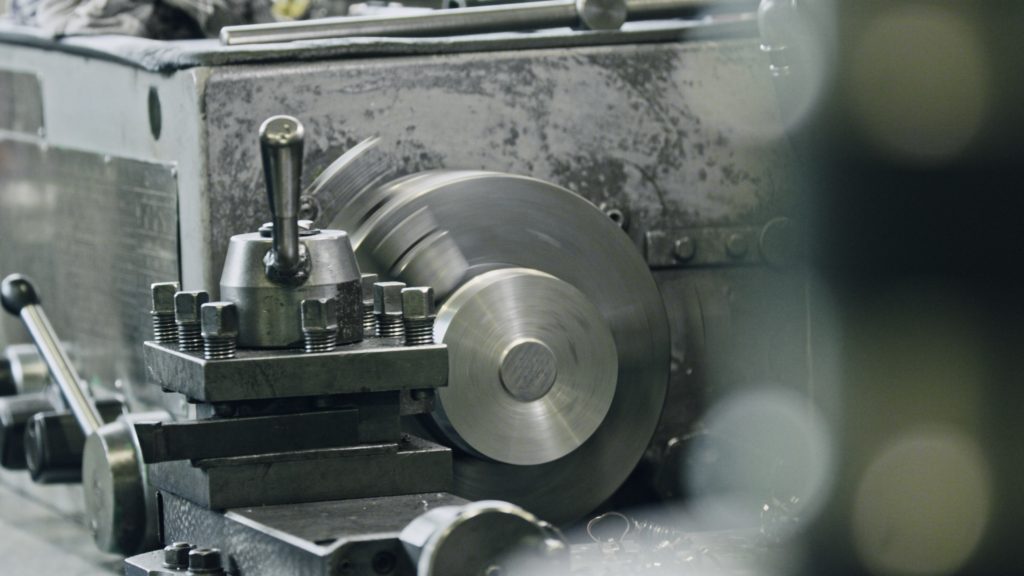
As manufacturing demands grow more complex, machines capable of handling larger, heavier, and more precise components have become essential. Among these, the vertical turret lathe has earned a reputation for strength, stability, and exceptional accuracy. Its unique design allows it to manufacture parts that challenge conventional machining methods, making it a cornerstone of heavy industry. In this article, we explore what makes the vertical turret lathe such a powerful tool in modern production.
What is a vertical turret lathe?
A vertical turret lathe (VTL) is a type of turning machine in which the spindle is positioned vertically, allowing the workpiece to sit flat on a rotating table. Unlike a traditional horizontal lathe, where the workpiece is held horizontally, the vertical orientation uses gravity to stabilize heavy parts during machining.
VTLs are primarily used for machining large-diameter, short-length components such as turbine casings, flywheels, gear blanks, bearing housings, and heavy flanges. The turret, mounted on a vertical column, holds multiple cutting tools that can perform various operations like turning, facing, boring, and threading—all within a single setup.
Benefits of vertical turret lathes
- Ideal for large, heavy parts – The vertical orientation supports weight naturally, eliminating the need for complex fixturing.
- High rigidity and stability – The robust structure enables deep cuts and high material removal rates without compromising accuracy.
- Improved safety and ergonomics – Operators can load and unload heavy parts more easily compared to horizontal lathes.
- Reduced setup time – Multi-tool turrets and CNC control allow multiple operations in a single setup, boosting productivity.
- Superior surface finish – Stable workholding and controlled cutting parameters deliver excellent surface quality on large surfaces.
- Automation-ready – Modern vertical lathes integrate with robotic loading systems, automatic tool changers, and digital monitoring for lights-out manufacturing.
Types of vertical turret lathes
VTLs are categorized based on size, automation level, and configuration.
- Single-column VTL – Compact and cost-effective, suited for medium-sized workpieces. Offers good accessibility and ease of setup. This configuration is ideal for general-purpose machining where floor space and operational flexibility are priorities.
- Double-column (gantry) VTL – Provides maximum rigidity and stability for very large or heavy parts. The twin-column design minimizes deflection during high-load machining. It’s the preferred choice for industries like power generation and aerospace, where precision must be maintained under extreme cutting forces.
- CNC vertical turning center – The modern evolution of the VTL, featuring computer numerical control for automatic tool changes, multi-axis movement, and integration with digital manufacturing systems. These machines enable high-precision, automated production and are often equipped with live tooling for combined turning and milling operations.
How a vertical turret lathe works
The working principle of a vertical turret lathe (VTL) is similar to that of a conventional lathe, but with the spindle rotated 90 degrees. This vertical orientation allows the machine to handle large, heavy components with superior stability and accessibility. The workflow typically involves:
- Workholding and setup – The workpiece is clamped onto a large, circular table (chuck) mounted on the vertical spindle. Hydraulic or mechanical clamping ensures rigidity during cutting, while the table’s diameter determines the maximum part size the machine can accommodate. Precision alignment during setup is critical, as even minor deviations can lead to imbalance or surface irregularities in large workpieces. Many modern VTLs also feature automated pallet systems to speed up part loading and minimize operator handling of heavy components.
- Rotation – The spindle motor drives the table, rotating the workpiece at a controlled speed. The vertical layout keeps the part supported by its own weight, reducing deflection and vibration—especially important for large, heavy components. Variable-speed drives allow the spindle to adjust RPM dynamically, optimizing cutting conditions for different materials and tool types. This ensures smoother cutting performance and extends both tool and spindle life.
- Tool engagement – Cutting tools are mounted on the machine’s turret or ram head, which moves along vertical and horizontal axes. The turret indexes automatically to switch tools for different operations, while CNC-controlled VTLs can execute complex toolpaths with high precision. Depending on the configuration, the ram may include live tooling for milling, drilling, or tapping—allowing multiple processes in one setup. This flexibility makes VTLs particularly valuable in production environments requiring both roughing and finishing on large parts.
- Machining process – Typical operations include facing, turning, boring, grooving, and taper cutting. The large working envelope and rigid structure allow for deep cuts and high material removal rates. CNC-controlled versions use adaptive toolpath strategies to balance productivity and precision, maintaining surface finish even during heavy roughing. Multi-tool turrets enable sequential operations without stopping the spindle, further reducing cycle time.
- Monitoring and control – In modern CNC VTLs, sensors, encoders, and feedback systems monitor spindle load, axis position, and vibration to maintain accuracy and prevent tool wear or damage. Real-time process monitoring allows automatic compensation for thermal expansion and tool deflection, ensuring consistent machining accuracy over long production runs. Many advanced systems integrate with smart factory software, enabling remote diagnostics, predictive maintenance, and data-driven performance optimization.
Key parts of a vertical turret lathe
While designs vary by manufacturer, most VTLs share the following major components.
- Base and column – Provide the structural foundation and absorb cutting forces. Their rigidity is crucial for maintaining stability during heavy-duty machining. A well-designed base minimizes vibration and thermal distortion, ensuring consistent accuracy even under high loads and prolonged operation.
- Rotary table (chuck) – A large, circular table that holds and rotates the workpiece. Equipped with T-slots or jaw chucks for secure clamping, the table is driven by a geared spindle system for high torque and smooth rotation. The table’s size directly defines the maximum part diameter, and its rotational precision determines the concentricity and surface quality of machined components.
- Turret or ram head – The tool-carrying component that moves vertically (Z-axis) and horizontally (X-axis). It holds multiple tools for sequential machining operations without manual intervention. Some CNC vertical lathes include live tooling for milling and drilling functions, turning them into true multitasking machines capable of complete machining in one setup.
- Cross rail (or bridge) – Supports the ram and provides vertical movement, adjustable to accommodate workpieces of varying heights. On large machines, the cross rail can be motorized for automatic positioning. Its structural stiffness is essential to prevent deflection during high-force cutting, especially when working with tall or asymmetrical components.
- Spindle drive system – Powers the rotary table and provides precise speed control. High-torque drives are essential for handling the inertia of large, heavy parts. Modern VTLs use variable-frequency drives (VFDs) or direct-drive motors for smoother acceleration, better energy efficiency, and improved speed regulation.
- CNC control unit (on modern VTLs) – Executes programmed toolpaths, manages tool changes, and monitors real-time cutting conditions. Advanced systems can integrate with CAD/CAM for complex part geometries. Many include diagnostic functions, adaptive control, and data logging for process optimization and predictive maintenance.
Common operations on a vertical turret lathe
Vertical turret lathes can perform a wide range of operations depending on part geometry and tooling configuration.
- Facing – Creating flat surfaces perpendicular to the spindle axis. This operation ensures that the workpiece end is square and smooth, providing a precise reference surface for subsequent machining steps.
- Turning – Reducing the outer diameter of the workpiece to the desired dimension. It is one of the primary operations on a VTL, producing cylindrical surfaces with excellent dimensional accuracy and surface finish.
- Boring – Enlarging internal holes with high accuracy. This process refines previously drilled holes, achieving tight tolerances and smooth finishes for critical fits such as bearing housings or valve seats.
- Grooving and parting – Producing recesses or separating finished components. Grooves can serve functional purposes such as seating O-rings or retaining rings, while parting precisely cuts off completed parts from raw stock.
- Taper turning – Machining conical surfaces or transitions. It is commonly used for components such as hubs, adapters, and couplings that require angled surfaces for assembly or load distribution.
- Drilling and threading – Achieved with tool holders or live tooling systems. These operations allow the addition of axial holes or threaded features without transferring the part to another machine, improving workflow efficiency.
CNC VTLs can combine these operations seamlessly in one setup, reducing handling time and improving accuracy.
Applications of vertical turret lathes
VTLs are widely used in industries that require machining of large, round, or heavy components, including:
- Aerospace – Jet engine cases, landing gear components, turbine disks.
- Energy – Wind turbine hubs, power generation housings, valve bodies.
- Automotive – Brake drums, clutch housings, flywheels.
- Heavy equipment – Construction machinery parts, pump impellers, and gears.
Conclusion
The vertical turret lathe stands as a cornerstone of heavy-duty precision manufacturing. Its ability to handle oversized parts with stability, accuracy, and versatility makes it essential in industries demanding performance at scale. With ongoing advancements in automation, live tooling, and digital integration, modern VTLs deliver greater productivity and process control than ever before. As manufacturers continue to push the boundaries of efficiency and precision, the VTL remains a vital machine for shaping the future of industrial machining.