
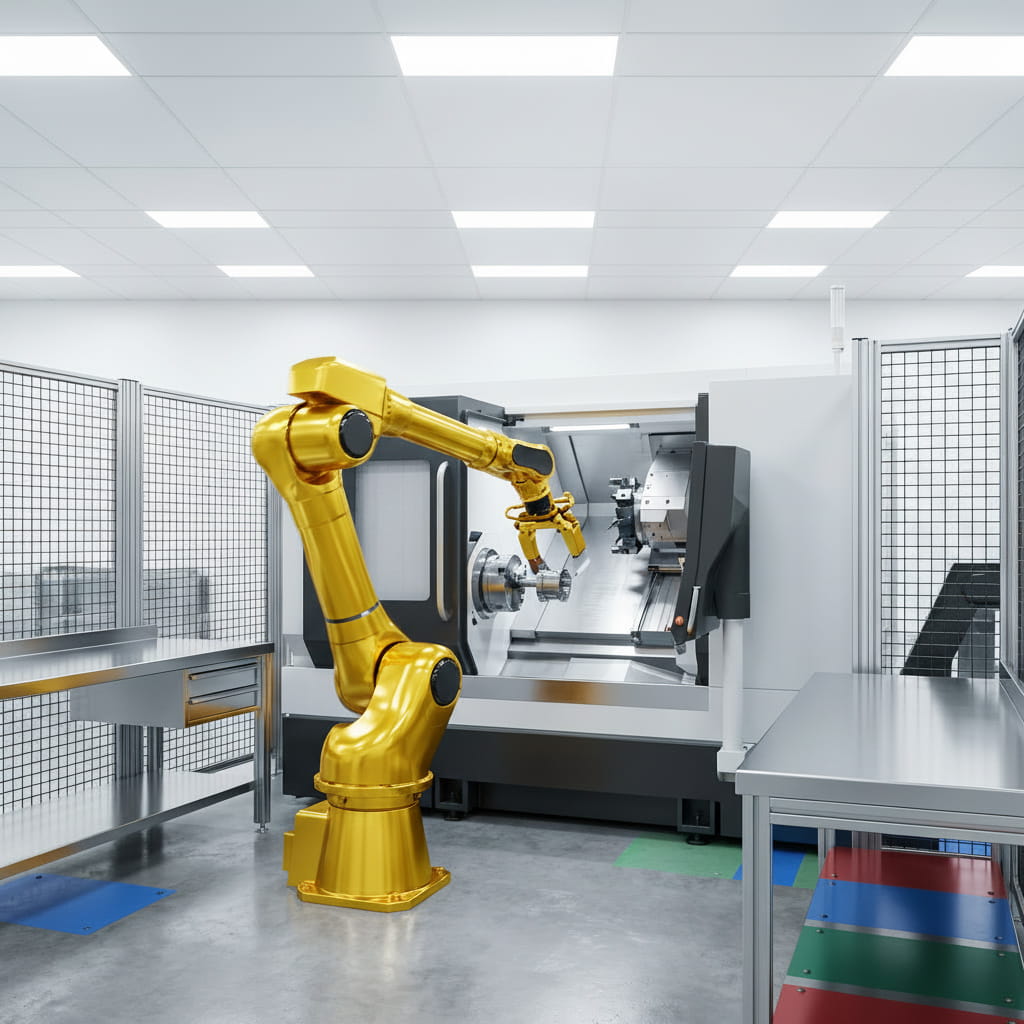
Automation cells usually do not fail because a robot cannot move accurately. They fail because the tooling and interfaces cannot locate, grip, clamp, and verify parts consistently in real shop conditions. Coolant changes friction, chips block seating surfaces, locator pins wear, and a small mismatch in part presentation can stop an entire automation system. That is why automation tooling is the practical layer that turns an automation project into dependable production.
In this article, you will learn what automation tooling is, the main types of tooling used in industrial automation, the benefits it delivers, and how to select a solution that improves efficiency, precision, and uptime.
What is automation tooling?
Automation tooling refers to the hardware designed to support automated part handling and machining with minimal manual input. It includes robot end-effectors, fixtures, pallet interfaces, sensing and inspection devices, and the supporting equipment that keeps an automated cell stable. In other words, it is the tooling that connects a robot, a machine, and the component into a repeatable process.
A good automation tooling solution answers four questions every cycle:
- How will the robot pick and place the part without damage?
- How will the part be located and clamped to the correct datums every time?
- How will the system confirm the right part is present and fully seated?
- How will the cell recover quickly when something is out of position?
If those questions are not engineered into the tooling, the system will require frequent intervention, which increases risk and reduces productivity.
Why automation tooling matters
Automation tooling directly impacts the outcomes most manufacturers care about.
- Uptime and reliability: Stable tooling reduces small interruptions caused by chips, coolant, wear, or misloads.
- Part quality: Repeatable location and consistent clamping protect tolerances and reduce rework.
- Cycle time: Faster handling is only valuable when it is repeatable and safe, which is why well-designed tooling can improve throughput.
- Scalability: Standard interfaces make it easier to add new parts, new machines, or new variants without redesigning the entire system.
This is also where flexible automation becomes realistic. When tooling and interfaces are standardized, you can switch jobs faster and keep the cell productive even as demand changes.
Types of automation tooling
Automation tooling generally falls into several categories, and most production cells use a combination of them.
End-of-arm tooling (EOAT)
EOAT is the gripper or end-effector mounted on a 6-axis robot (or gantry) that handles parts. EOAT must match the part’s size, weight, surface condition, and how it should be presented to the machine.
Common EOAT types include:
- Mechanical grippers: Robust for most rigid parts and common in machining environments.
- Vacuum end-effectors: Useful for flatter parts, but sensitive to surface condition and contamination.
- Magnetic end-effectors: Useful for ferrous parts, with a plan for chip contamination and release.
- Servo/adaptive grippers: Helpful for high-mix applications where part geometry varies.
- Dual grippers: Reduce door-open time by loading and unloading in one robot cycle when cycle balance and safety allow.
Practical EOAT features that improve reliability:
- Part-present sensing
- Hard stops for repeatable location
- Quick-change couplers so the robot can swap tools
- Protective covers to keep coolant and chips out of moving elements
Workholding and clamping systems
Workholding determines whether the process is accurate. A robot can load perfectly, but if the fixture does not locate the part the same way every time, the machining result will drift.
Common automation workholding includes:
- Hydraulic fixtures: Consistent clamping force and fast actuation for production.
- Pneumatic fixtures: Clean and simple for lighter loads.
- Mechanical clamps/vises: Straightforward and durable when simplicity matters.
- Self-centering fixtures: Useful for round parts that require concentric location.
Strong workholding design focuses on:
- Chip clearance and drain paths
- Replaceable wear components (pins, bushings, pads)
- Error-proofing that prevents wrong-way loading
- Serviceability for quick maintenance
Zero-point and quick-change interfaces
Zero-point clamping systems standardize how fixtures and pallets mount to the machine table. This reduces changeover time and supports repeatable positioning, which is critical when a cell runs many part numbers.
A standardized interface is also a key enabler of modular automation. When pallets, nests, and fixtures share the same locating pattern, you can expand capacity or add new projects without redesigning the foundation.
Pallets, tombstones, and part presentation
Automation requires predictable part presentation. Pallets and nests act as “packaging” for workpieces so the robot and machine always see the same geometry.
Common solutions include:
- Pallet systems for CNC mills
- Tombstones for horizontal machining
- Trays and nests for batch handling and storage
- Conveyors and chutes for infeed/outfeed flow
The goal is to minimize robot motions while keeping loading orientation consistent.
Sensing, verification, and inspection tooling
Automation should assume errors will happen, then detect them before machining starts. Verification tooling reduces scrap risk and helps the cell recover quickly.
Typical tooling includes:
- Part-present sensors (inductive/optical/mechanical)
- Seat-check sensing to confirm full location
- In-machine probing routines
- In-line gauges or go/no-go checks
- Machine vision for part ID and orientation
If the cell supports traceability or regulated production (for example a medical device component), inspection and verification need to be engineered into the process, not added later.
Cleaning and chip management tooling
Chip packing and coolant carryover are common reasons an automated system stops.
Common supporting tools include:
- Air blow-off or air knife stations
- Chip brushes and wipers
- Wash/rinse stations (when required)
- Coolant drip management and drain design
- Part drying stations when downstream inspection or packaging requires it
Tool changers and tooling storage
Some cells use tool changers so the robot can switch between different end-effectors, which reduces manual intervention and supports higher mix.
Typical elements include:
- EOAT tool changers
- Tool racks and organized storage stations
- Pallet and fixture staging areas
At the CNC machine level, a reliable ATC (automatic tool changer) supports unattended machining, but the automation tooling must still manage parts and verification correctly.
Benefits of good automation tooling
When tooling is engineered as part of the automation system, the benefits become measurable.
- Higher uptime: fewer stops from chips, misloads, or seating failures.
- Better quality: stable datums and clamp consistency improve repeatability.
- Lower production risk: verification prevents costly scrap events.
- Better changeover performance: standardized interfaces shorten changeover and support mixed production.
- Improved productivity: smoother handling and fewer interventions reduce idle time.
In sectors like automotive, these gains often show up as more predictable output per shift and more stable delivery performance.
How to choose the right automation tooling
Tooling selection should start with the part and the process, then work backward to the robot and equipment.
1) Define the handling problem
Identify where the robot can grip without damaging the part, and whether surfaces are oily, wet, or sensitive. Consider how the part will be presented to the machine and whether a press fit or critical interface must be protected.
2) Engineer the locating strategy
Choose datums and design locators so the part seats the same way every cycle. Add chip relief, drain paths, and replaceable wear components.
3) Build in error-proofing
Add sensors and mechanical poka-yoke features so the system can detect wrong orientation, missing parts, or incomplete seating.
4) Standardize interfaces
Standard gripper couplers, pallet interfaces, and fixture mounting patterns reduce engineering time and make scaling easier.
5) Plan maintenance and service
Design fixtures so wear parts can be replaced quickly, and ensure access for cleaning and inspection. Reliability depends on serviceability.
6) Validate in real conditions
Tooling that works in a clean pilot demo can fail in production because chips, coolant, burrs, and variation are real. Validate with realistic cycle conditions before full deployment.
Common mistakes to avoid
- Choosing a gripper without considering coolant, burrs, and chip contamination
- Clamping on cosmetic or functional surfaces that can be damaged
- Underestimating locator wear and not designing replaceable wear components
- Skipping verification and assuming the robot will always load correctly
- Over-customizing every fixture instead of building a standardized, modular concept
Conclusion
Automation tooling is the bridge between a robot, a machine, and repeatable automated production. The most successful automation tooling solutions focus on reliable location, consistent clamping, verification, and survival in real shop conditions. When you standardize interfaces and engineer for chips, coolant, and wear, you enhance uptime and protect part quality. Treat tooling as the foundation of the cell, and automation becomes scalable, reliable, and cost-effective.